Skip to content

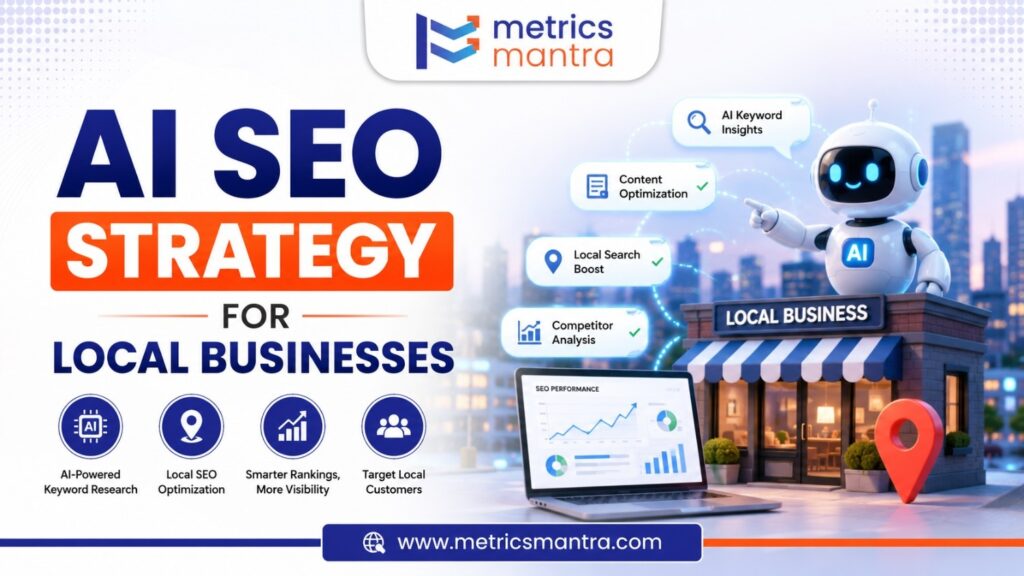
More customers are using Google and AI-powered search to find local businesses than ever before. If your business isn’t visible online, you’re losing potential leads to your competitors. A smart AI SEO strategy for local businesses can help improve your Google rankings, increase local visibility, and attract more qualified customers.
In this guide, you’ll learn simple and effective ways to use AI for local SEO, optimize your online presence, and grow your business with practical strategies that deliver long-term results.
Why AI SEO Matters for Local Businesses
AI is changing the way people search for local businesses online. Instead of typing simple keywords like “best digital marketing agency near me,” users now ask detailed questions such as, “Which is the best digital marketing agency in Varanasi for local SEO?” Search engines use AI to understand these queries and provide the most relevant and trustworthy answers. This is why having an effective AI SEO strategy for local businesses is no longer optional—it’s essential.
AI Understands Search Intent Better
Modern search engines don’t just match keywords; they understand what users are actually looking for. By creating helpful, well-structured, and locally relevant content, businesses have a better chance of appearing in Google Search, Google AI Overviews, and other AI-powered search platforms.
Helps Improve Local Search Rankings
AI evaluates multiple local ranking factors, including your Google Business Profile, website content, customer reviews, business information, and local relevance. Optimizing these elements makes it easier for search engines to recommend your business to nearby customers searching for your products or services.
Brings More Qualified Local Customers
Unlike traditional marketing, AI SEO focuses on users with high purchase intent. When your business appears for relevant local searches, you’re more likely to attract people who are ready to contact, visit, or buy from your business, leading to better-quality leads and higher conversion rates.
Supports Better Content Creation
AI helps businesses identify trending topics, discover valuable keywords, and create content that answers real customer questions. Publishing useful blogs, service pages, and FAQs regularly improves your website’s authority and strengthens your overall local SEO strategy.
Improves User Experience
Search engines prefer websites that are easy to navigate, load quickly, and provide clear answers. AI can help identify technical issues, improve content structure, and enhance website performance, creating a better experience for both users and search engines.
Keeps You Ahead of Competitors
Many local businesses still rely only on traditional SEO techniques. By adopting an AI SEO strategy for local businesses, you can adapt to changing search trends, optimize for AI-powered search results, and gain a competitive advantage in your local market.
Key Benefits of AI SEO for Local Businesses
- Improves visibility in local search results and Google Maps.
- Helps attract more targeted local customers.
- Enhances your Google Business Profile performance.
- Creates high-quality, search-intent-focused content.
- Saves time by automating keyword and content research.
- Increases organic traffic, leads, and long-term business growth.
How AI Search Engines Find Local Businesses
AI-powered search engines like Google AI Overviews, ChatGPT, Gemini, Perplexity, and Bing Copilot don’t just look at keywords anymore. They try to understand which local businesses are the most trustworthy, relevant, and helpful for a user’s search. A strong AI SEO strategy for local businesses focuses on building credibility across your website, Google Business Profile, and other trusted online platforms so AI can confidently recommend your business.

Google AI Overviews
Google AI Overviews collect information from multiple trusted sources to provide quick answers at the top of search results. To improve your chances of being featured, keep your website updated with helpful content, optimize your Google Business Profile, use structured data (Schema markup), and maintain consistent business details across the web.
ChatGPT
ChatGPT recommends businesses based on reliable online information rather than a single website. It considers factors like your website’s authority, customer reviews, business directories, and mentions on trusted websites. Publishing high-quality, locally focused content and earning positive reviews can improve your visibility in AI-powered search.
Google Gemini
Google Gemini works closely with Google’s search ecosystem and values businesses that provide clear, accurate, and well-organized information. Optimized local landing pages, relevant FAQs, updated business details, and helpful content increase your chances of appearing in Gemini-generated responses.
Perplexity AI
Perplexity AI provides answers with source citations, making trust and authority even more important. Businesses with informative blog posts, quality backlinks, positive customer reviews, and strong local SEO signals are more likely to be referenced in the results.
Bing Copilot
Bing Copilot combines Bing Search with AI to recommend businesses that have complete business profiles, relevant website content, and consistent local information. Optimizing your business for both Google and Bing can help you reach a wider audience through AI-powered search.
Key Factors AI Uses to Recommend Local Businesses
To improve your AI SEO strategy for local businesses, focus on these important ranking signals:
- Relevant Content: Create helpful, original content that answers real customer questions.
- Google Business Profile: Keep your profile complete with accurate contact details, business hours, services, and photos.
- Customer Reviews: Encourage genuine reviews and respond to them regularly to build trust.
- Local Citations: Ensure your business name, address, and phone number (NAP) remain consistent across all directories.
- Schema Markup: Use Local Business Schema to help AI understand your business information.
- Website Authority: Earn quality backlinks and publish expert content to strengthen your online credibility.
- User Experience: A fast, mobile-friendly, and secure website improves both SEO and AI search visibility.
AI SEO vs Traditional Local SEO
Both AI SEO and traditional local SEO help businesses improve their online visibility, but they use different approaches. Traditional local SEO focuses on ranking your website and Google Business Profile in Google Search and Maps. In contrast, an AI SEO strategy for local businesses helps your business appear in AI-powered search results like Google AI Overviews, ChatGPT, and voice search by creating helpful, intent-focused content.
AI SEO vs Traditional Local SEO: Comparison
| Feature | Traditional Local SEO | AI SEO |
| Focus | Keywords & Google rankings | User intent & AI search visibility |
| Platforms | Google Search & Maps | Google AI Overviews, ChatGPT, Gemini |
| Content | Keyword-focused | Helpful, conversational, and comprehensive |
| Goal | Improve local rankings | Increase visibility in AI-powered search |
Complete AI SEO Strategy for Local Businesses
A successful AI SEO strategy for local businesses is not just about using AI tools to create content. It combines artificial intelligence with proven local SEO practices to help your business rank higher in Google Search, Google Maps, and AI-powered search results. Follow these steps to build a strong local online presence and attract more qualified customers.
Step 1: Find the Right Local Keywords with AI
Start by identifying what your potential customers are searching for. Use AI-powered tools like ChatGPT, Google Keyword Planner, Ahrefs, or Semrush to discover high-intent keywords related to your business. Focus on keywords that include your service and location, such as “digital marketing agency in Varanasi” or “SEO services near me.” Also, target long-tail keywords that answer common customer questions.
Step 2: Optimize Your Google Business Profile
Your Google Business Profile (GBP) plays a major role in local search rankings. Ensure your business name, address, phone number (NAP), website, business hours, services, and categories are accurate. Use AI to write engaging business descriptions, service details, and regular Google Posts. Upload high-quality images and encourage satisfied customers to leave genuine reviews.
Step 3: Create Helpful, Local-Focused Content
Publish content that solves real problems for your audience instead of writing only for search engines. Create blogs, service pages, FAQs, and location-specific content that answer local search queries. AI can help generate ideas, but every article should be edited to include real expertise, examples, and local insights.
Step 4: Improve Your Website Structure
A fast, mobile-friendly, and easy-to-navigate website improves both user experience and SEO. Organize your content with clear headings, internal links, optimized images, and descriptive URLs. AI tools can also help identify technical SEO issues and suggest improvements that make your website easier for search engines to crawl.
Step 5: Add Local Schema Markup
Use Local Business Schema to help search engines understand your business information. Schema markup provides details such as your business name, address, phone number, services, reviews, and operating hours. This can improve your visibility in search results and increase the chances of earning rich snippets.
Step 6: Build Strong Local Citations
List your business on trusted online directories and ensure your NAP details remain consistent across every platform. Accurate local citations improve credibility and strengthen your local SEO strategy, helping search engines trust your business information.
Step 7: Collect and Respond to Customer Reviews
Online reviews influence both rankings and customer trust. Encourage happy customers to leave reviews on your Google Business Profile and other relevant platforms. Respond to every review professionally, whether positive or negative, to show that you value customer feedback and maintain an active online presence.
Step 8: Optimize Images and Local Media
Use original, high-quality images with descriptive file names and alt text that include relevant keywords where appropriate. Compress images to improve website speed and add location-specific photos to your Google Business Profile to enhance local relevance.
Step 9: Build Trust with EEAT
Google values websites that demonstrate Experience, Expertise, Authoritativeness, and Trustworthiness (EEAT). Share expert-written content, showcase client testimonials, display certifications, publish case studies, and keep your business information updated to build credibility with both users and search engines.
Step 10: Track Performance and Improve Regularly
SEO is an ongoing process. Monitor your rankings, website traffic, Google Business Profile insights, conversions, and keyword performance using tools like Google Search Console and Google Analytics. Use AI to identify trends, discover new content opportunities, and continuously refine your AI SEO strategy for local businesses for better long-term results.
Best AI SEO Tools for Local Businesses
The right AI tools can make your AI SEO strategy for local businesses faster and more effective. They help with keyword research, content optimization, competitor analysis, and local SEO, allowing you to improve your Google rankings and attract more local customers.
ChatGPT – Best for Content Creation
Create SEO-friendly blogs, FAQs, meta tags, Google Business Profile posts, and keyword ideas.
Google Gemini – Best for Search Intent
Understand user search intent, generate content ideas, and create helpful content for local audiences.
Semrush – Best for Keyword Research
Find high-volume keywords, analyze competitors, track rankings, and discover new SEO opportunities.
Ahrefs – Best for Backlink Analysis
Monitor backlinks, identify content gaps, and improve your website’s SEO performance.
Surfer SEO – Best for On-Page SEO
Optimize headings, keywords, content structure, and readability based on top-ranking pages.
BrightLocal – Best for Local SEO
Manage Google Business Profile, local citations, online reviews, and local keyword rankings.
Google Search Console – Best for SEO Monitoring
Track keyword performance, website indexing, clicks, and technical SEO issues for better search visibility.
AI SEO Checklist for Local Businesses
A well-planned AI SEO strategy for local businesses is more than just using AI tools to create content. It requires optimizing your website, Google Business Profile, local listings, and user experience so that both search engines and AI-powered search platforms can understand and recommend your business. Use this checklist to make sure you are covering the most important areas.
Website Optimization Checklist
- Create helpful, original content that answers your customers’ questions.
- Use your primary keyword and related keywords naturally in headings and content.
- Optimize title tags, meta descriptions, and image alt text.
- Make your website mobile-friendly and fast-loading.
- Add clear calls-to-action (CTAs) on every important page.
- Create dedicated location and service pages for your target areas.
- Link related pages internally to improve navigation and SEO.
Google Business Profile Optimization Checklist
- Keep your business name, address, and phone number (NAP) consistent across all platforms.
- Select the correct business categories.
- Add high-quality photos and update them regularly.
- Write a keyword-rich business description without overusing keywords.
- Publish Google Business Profile posts regularly.
- Encourage happy customers to leave genuine reviews and respond to every review professionally.
- Keep business hours, services, and contact details updated.
Technical SEO Checklist
- Use HTTPS to keep your website secure.
- Improve Core Web Vitals for better user experience.
- Submit an XML sitemap to Google Search Console.
- Fix broken links and redirect errors.
- Add Local Business Schema to help search engines understand your business.
- Ensure all important pages are indexed properly.
Content Optimization Checklist
- Focus on solving real customer problems instead of only targeting keywords.
- Update old blog posts with the latest information.
- Add FAQs to increase the chances of appearing in featured snippets.
- Use images, tables, and bullet points to improve readability.
- Optimize content for voice search by answering questions in simple language.
Local SEO & Reviews Checklist
- Build consistent local citations on trusted directories.
- Collect authentic Google reviews regularly.
- Respond to customer feedback quickly.
- Mention your target city or service area naturally where relevant.
- Earn backlinks from trusted local websites and business directories.
AI Search Readiness Checklist
- Use AI tools for keyword research, content planning, and SEO audits—not just content generation.
- Fact-check and edit all AI-generated content before publishing.
- Demonstrate Experience, Expertise, Authoritativeness, and Trustworthiness (E-E-A-T) in every article.
- Create content that directly answers users’ search intent to improve visibility in AI-powered search results and Google AI Overviews.
- Monitor your SEO performance regularly using tools like Google Search Console and Google Analytics, and refine your strategy based on data.
Also Read: https://metricsmantra.com/why-core-web-vitals-matter-for-seo/
Conclusion
A well-planned AI SEO strategy for local businesses can help you improve your local SEO, increase your visibility in Google Search and Google Maps, and attract more qualified customers. By combining AI tools with high-quality content, an optimized Google Business Profile, local citations, and technical SEO, you can build a strong online presence that delivers long-term results. Instead of relying only on traditional SEO, start using AI to understand customer intent, optimize your website, and stay ahead of your competitors. With consistent efforts and regular updates, your local business can achieve better rankings, generate more leads, and grow faster in today’s AI-driven search landscape.
Frequently Asked Questions
1. What is an AI SEO Strategy for Local Businesses?
An AI SEO strategy for local businesses is the process of using artificial intelligence to improve your local search rankings and online visibility. AI helps with keyword research, content creation, competitor analysis, and website optimization, making it easier to attract nearby customers through Google Search and Google Maps.
2. How does AI improve local SEO?
AI improves local SEO by analyzing search trends, identifying the right keywords, optimizing content, and helping businesses maintain an accurate Google Business Profile. It also saves time by automating repetitive SEO tasks while providing insights to improve search performance.
3. What are the best AI SEO tools for local businesses?
Some of the best AI SEO tools include ChatGPT, Google Gemini, Semrush, Ahrefs, Surfer SEO, BrightLocal, and Google Search Console. These tools help with keyword research, content optimization, local SEO audits, and performance tracking, allowing businesses to make data-driven decisions.
4. Can AI help improve Google Business Profile rankings?
Yes, AI can support Google Business Profile optimization by suggesting relevant keywords, creating engaging business descriptions, generating Google Posts, and analyzing customer reviews. However, maintaining accurate business information, collecting genuine reviews, and updating your profile regularly are equally important for better local rankings.
5. Is AI SEO better than traditional SEO?
AI SEO is not a replacement for traditional SEO but an enhancement. While traditional SEO focuses on proven optimization techniques, AI helps speed up research, improve content quality, and better understand user intent. Combining both approaches delivers the best long-term SEO results.
6. How long does AI SEO take to show results?
The timeline depends on your competition, website authority, and SEO efforts. Most local businesses start noticing improvements in rankings and traffic within 3 to 6 months when they consistently follow a strong AI SEO strategy and publish helpful, optimized content.
7. Does AI-generated content rank on Google?
Yes, AI-generated content can rank on Google if it is accurate, original, and provides real value to users. Always review, edit, and enhance AI-generated content with human expertise to ensure it meets Google’s quality guidelines and satisfies search intent.
8. What is the difference between AI SEO, AEO, and GEO?
AI SEO focuses on using artificial intelligence to improve search performance. AEO (Answer Engine Optimization) aims to optimize content for direct answers in search engines and AI assistants, while GEO (Generative Engine Optimization) helps content become more visible in AI-generated search results such as Google AI Overviews and ChatGPT-powered experiences.
9. Can small businesses use AI SEO on a limited budget?
Absolutely. Many AI SEO tools offer free or affordable plans that are suitable for small businesses. By using AI for keyword research, content planning, and Google Business Profile optimization, small businesses can improve their local search visibility without spending a large marketing budget.
10. How can Metrics Mantra help with AI SEO for local businesses?
Metrics Mantra helps businesses build a customized AI SEO strategy for local businesses that focuses on improving local SEO, optimizing Google Business Profiles, creating high-quality content, and increasing organic traffic. With data-driven strategies and ongoing optimization, businesses can achieve better rankings, generate more local leads, and grow their online presence.